 When America marks its 250th anniversary in 2026, the spotlight will naturally fall on Philadelphia, Boston, and the great halls where the nation’s founding ideals were written. But the story of the United States is not only the story of declarations and debates. It is also the story of the places that built the physical nation . . . . the towns whose labor, resources, and people powered the rise of an industrial republic.
Scottdale, Pennsylvania is one of those places. Its coal and coke legacy is not a footnote to American history. It is a chapter in the nation’s ascent.
A Town Born at the Turning Point of a Nation
Scottdale began as Fountain Mills, a small milling settlement that incorporated as a borough in 1874. Its renaming honored Thomas A. Scott, president of the Pennsylvania Railroad – a symbolic gesture that captured the moment when America was shifting from an agrarian society to an industrial one.
The borough sat atop the Connellsville Coke Region, home to some of the richest metallurgical coal seams in the world. When the Pennsylvania Railroad and B&O lines expanded through the area in the 1870s, Scottdale’s future changed overnight. Railroads connected the region’s coal to national markets, and the town transformed into a hub of mining, manufacturing, and industrial ambition.
The Coal and Coke Boom That Built an Industrial Nation
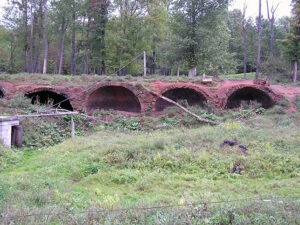
By the early 1900s, the region surrounding Scottdale held more than 30,000 beehive coke ovens, each one a blazing furnace converting coal into coke — the essential fuel for steelmaking. These ovens glowed through the night, their heat and smoke rising like a second sunrise over Western Pennsylvania.
Coke from Scottdale and its neighboring towns fed Pittsburgh’s steel mills, which in turn built the nations railroads, it’s skyscrapers, it’s bridges, and it’s wartime production in two world wars.
This was the industrial muscle behind America’s rise to global power.
The Frick and Overholt Legacy
Henry Clay Frick, born in nearby West Overton, founded the H.C. Frick Coke Company in Scottdale in 1871. From its headquarters in the borough, Frick built one of the largest coke operations in the world and later partnered with Andrew Carnegie to form the backbone of Carnegie Steel.
The Overholt family – Frick’s relatives – had already built early coke ovens in the 1870s, shifting from whiskey distilling to coal as the region’s industrial potential exploded.
A Town of Factories and Immigrants
Coke wealth fueled a diverse industrial base in Scottdale. Steel and iron pipe mills, brass and silver works, tin factories, knife and tool manufacturing, steam engine works, and even a casket factory.
Immigrant labor from Sweden, Ireland, Germany, and Eastern Europe powered the mines and ovens, making Scottdale a microcosm of the American melting pot.
Labor, Conflict, and the American Promise
The coal and coke industry was not only a story of growth – it was a story of struggle. Workers endured long hours, dangerous conditions, and the constant threat of injury or death. Company towns grew around the mines, offering housing and amenities but also tying workers tightly to their employers.
This era tested the nation’s ideals. The same decades that celebrated American opportunity also revealed deep inequalities between industrialists and laborers. Scottdale stood at the center of these tensions, especially as Frick’s influence grew and labor movements gained strength across the region.
In this way, the town’s history mirrors the broader American story: the pursuit of prosperity, the fight for fairness, and the ongoing effort to make the nation’s founding promises real for everyone.
Decline, Reinvention, and the Rust Belt Identity
The Great Depression hit the industry hard. Mines closed, coke ovens cooled, and Scottdale – like many towns in Western Pennsylvania – entered the long arc of Rust Belt decline. By the mid‑20th century, technological changes and competition had rendered traditional beehive ovens obsolete. Population fell, factories shuttered, and the borough faced the challenge of redefining itself in a post‑industrial world.
Yet one industrial survivor remains: Duraloy Technologies, founded in the 1920s, still producing heat‑resistant alloys and carrying forward a fragment of Scottdale’s manufacturing heritage.
Preserving the Legacy: Memory as Civic Work
Today, Scottdale honors its industrial past through preservation and storytelling.
The Coal and Coke Trail follows the old rail lines that once carried coke to Pittsburgh’s mills.
West Overton Village preserves Frick’s birthplace and the Overholt family’s early coke ovens.
The Scottdale Historic District showcases architecture from 1853 to 1950, capturing the town’s boom years.
These sites are not just historical markers. They are reminders of the people whose labor built the nation’s industrial foundation.
Why Scottdale Matters in America’s 250th Year
As the United States reflects on 250 years of independence, Scottdale offers a powerful lens for understanding the country’s evolution.
It shows how natural resources and innovation fueled national growth.
It highlights the immigrant labor that shaped American industry.
It reflects the tensions between capital and workers – a recurring theme in American life.
It embodies resilience in the face of economic transformation.
It preserves its past not as nostalgia, but as a guide for the future.
Scottdale’s story is the American story. Ambition, conflict, reinvention, and community.
A Patriotism Rooted in Work and Memory
As America celebrates its semiquincentennial, patriotism can mean more than ceremonies and fireworks. It can mean honoring the people who built the nation – not only the founders who wrote its ideals, but the workers who forged its steel, mined its coal, and fired its coke ovens.
In Scottdale, that history is still visible in the landscape, the architecture, and the stories passed down through generations. It is a reminder that the American experiment has always depended on ordinary people doing extraordinary work.
And as the nation looks ahead to its next 250 years, Scottdale stands as proof that small towns can shape big histories – and that the fires that once lit the coke ovens still burn in the memory of a community that helped build a country.