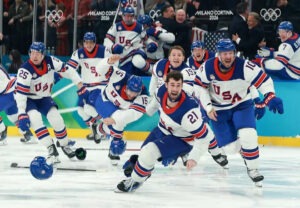
 By any rational measure, the United States hockey team should not have beaten the Soviet Union in 1980. And by any modern measure, the 2026 U.S. men’s team should not have rolled undefeated into a gold‑medal showdown with Canada. Yet both teams did something far more consequential than win hockey games. They arrived at moments when America was fractured, anxious, and unsure of itself, and they gave the country a reason to believe again.
These two teams, separated by 46 years, ended up performing the same civic function: they reminded Americans that unity is still possible, even if only for the length of a hockey game.
A Nation in Turmoil – Twice
1980: A Country Running on Empty
The Miracle on Ice didn’t happen in a vacuum. It happened in a country worn down by:
- Inflation and recession
- The Iran hostage crisis
- A crisis of confidence in government
- A Cold War that felt like it was tightening, not thawing
Americans weren’t just discouraged . . . . they were exhausted. The victory over the Soviets wasn’t merely an upset; it was a symbolic reversal of national mood. It felt like the country had finally punched back.
2026: A Different Kind of Fracture
Fast‑forward to Milan‑Cortina, and the U.S. arrived at the Olympics in a world defined by:
- Global conflict and geopolitical tension
- Economic uncertainty
- Deep political polarization at home
- A public square dominated by cynicism
The 2026 team wasn’t a band of amateurs. They were elite, disciplined, and expected to win. But the emotional stakes were strangely similar: Americans were desperate for something, anything, that wasn’t divisive.
And then this team delivered a run that felt like a national exhale.
Two Teams, Two Identities – One Impact
1980: The Kids Who Shocked the World
Herb Brooks’ roster was young, unpolished, and dismissed by every expert. They were amateurs facing a Soviet machine that had dominated global hockey for decades. Their win wasn’t just improbable . . . . it was impossible.
But that impossibility was the point. It allowed Americans to believe that maybe the country wasn’t as broken as it felt.
2026: The Team Built for the Moment
The 2026 squad was the opposite:
- Veteran leadership
- NHL‑caliber skill
- A system designed to win, not survive
They didn’t sneak up on anyone. They imposed themselves. And yet, their undefeated march to the gold‑medal game carried the same emotional weight as 1980, not because they were underdogs, but because they were a reminder of American excellence at a time when the country doubted its own.
Why These Wins Mattered Beyond the Ice
1980 changed how Americans felt
It restored something intangible: national confidence. For a brief moment, the country wasn’t arguing. It was cheering.
2026 changed how Americans connected
In a hyper‑polarized era, the team’s run created a rare, shared experience. People weren’t debating politics, they were debating line combinations. They weren’t doomscrolling, they were scoreboard watching.
Both teams, in their own ways, cut through the noise.
The Aftermath: What Happens When a Country Believes Again
The Miracle on Ice helped usher in a renewed sense of American optimism that carried into the decade. It didn’t fix the economy or end the Cold War, but it shifted the national mood, and moods matter.
The 2026 team’s impact is still unfolding, but the early signs are familiar:
- A surge in youth hockey interest
- A rare moment of bipartisan celebration
- A reminder that national pride doesn’t have to be a political statement
In a country that often feels like it’s arguing with itself, the 2026 team gave Americans something to rally around without hesitation or caveat.
Two Miracles, One Legacy
The 1980 and 2026 U.S. hockey teams were built differently, played differently, and lived in different worlds. But they share a legacy that transcends sports:
They showed America who it could be at moments when America wasn’t sure anymore.
One team shocked the world. The other steadied it.
Both changed it.
About Joe Levandosky
Joe Levandosky has been chronicling the highs, lows, and eyebrow-raising moments of Scottdale life since before the borough had Wi-Fi. When he's not chasing down town council drama or decoding zoning ordinances written in ancient bureaucratese, he's probably sipping lukewarm coffee and muttering about potholes.
A lifelong resident with a sixth sense for spotting political nonsense from 50 yards, Joe believes in transparency, accountability, and the sacred right to complain about parking. His opinions blend investigative grit with just enough sarcasm to keep things spicy—because in small-town politics, truth is often stranger than fiction.
He’s been called “
the voice of reason,” “
a thorn in someone’s side,” and once, “
the guy who knows too much about sewer budgets.” He wears all titles proudly.










Two Miracles, Two Moments of Reckoning
These two teams, separated by 46 years, ended up performing the same civic function: they reminded Americans that unity is still possible, even if only for the length of a hockey game.
A Nation in Turmoil – Twice
1980: A Country Running on Empty
The Miracle on Ice didn’t happen in a vacuum. It happened in a country worn down by:
Americans weren’t just discouraged . . . . they were exhausted. The victory over the Soviets wasn’t merely an upset; it was a symbolic reversal of national mood. It felt like the country had finally punched back.
2026: A Different Kind of Fracture
Fast‑forward to Milan‑Cortina, and the U.S. arrived at the Olympics in a world defined by:
The 2026 team wasn’t a band of amateurs. They were elite, disciplined, and expected to win. But the emotional stakes were strangely similar: Americans were desperate for something, anything, that wasn’t divisive.
And then this team delivered a run that felt like a national exhale.
Two Teams, Two Identities – One Impact
1980: The Kids Who Shocked the World
Herb Brooks’ roster was young, unpolished, and dismissed by every expert. They were amateurs facing a Soviet machine that had dominated global hockey for decades. Their win wasn’t just improbable . . . . it was impossible.
But that impossibility was the point. It allowed Americans to believe that maybe the country wasn’t as broken as it felt.
2026: The Team Built for the Moment
The 2026 squad was the opposite:
They didn’t sneak up on anyone. They imposed themselves. And yet, their undefeated march to the gold‑medal game carried the same emotional weight as 1980, not because they were underdogs, but because they were a reminder of American excellence at a time when the country doubted its own.
Why These Wins Mattered Beyond the Ice
1980 changed how Americans felt
It restored something intangible: national confidence. For a brief moment, the country wasn’t arguing. It was cheering.
2026 changed how Americans connected
In a hyper‑polarized era, the team’s run created a rare, shared experience. People weren’t debating politics, they were debating line combinations. They weren’t doomscrolling, they were scoreboard watching.
Both teams, in their own ways, cut through the noise.
The Aftermath: What Happens When a Country Believes Again
The Miracle on Ice helped usher in a renewed sense of American optimism that carried into the decade. It didn’t fix the economy or end the Cold War, but it shifted the national mood, and moods matter.
The 2026 team’s impact is still unfolding, but the early signs are familiar:
In a country that often feels like it’s arguing with itself, the 2026 team gave Americans something to rally around without hesitation or caveat.
Two Miracles, One Legacy
The 1980 and 2026 U.S. hockey teams were built differently, played differently, and lived in different worlds. But they share a legacy that transcends sports:
They showed America who it could be at moments when America wasn’t sure anymore.
One team shocked the world. The other steadied it.
Both changed it.
About Joe Levandosky
Joe Levandosky has been chronicling the highs, lows, and eyebrow-raising moments of Scottdale life since before the borough had Wi-Fi. When he's not chasing down town council drama or decoding zoning ordinances written in ancient bureaucratese, he's probably sipping lukewarm coffee and muttering about potholes. A lifelong resident with a sixth sense for spotting political nonsense from 50 yards, Joe believes in transparency, accountability, and the sacred right to complain about parking. His opinions blend investigative grit with just enough sarcasm to keep things spicy—because in small-town politics, truth is often stranger than fiction. He’s been called “the voice of reason,” “a thorn in someone’s side,” and once, “the guy who knows too much about sewer budgets.” He wears all titles proudly.